Why Some Vancouver Therapy Practices Struggle to Show Up in Google Search
Many therapy clinics and solo practitioners build successful practices through strong referrals and word of mouth.
And those things absolutely still matter.
Referrals remain one of the strongest trust signals a counselling practice can have. However, relying too heavily on referrals alone can create visibility gaps over time.
Many therapists also rely heavily on directories.
While those platforms are still important and support local SEO, many potential clients are also independently searching on Google to compare therapists, read reviews, browse websites, and evaluate their options privately.
Practices with stronger local search visibility and clearer online infrastructure are far more likely to appear consistently where potential clients are already searching.
So if you are wondering why your therapy practice is not showing up online despite having a strong reputation, this article breaks down some of the most common visibility gaps affecting therapy practices in Vancouver.
Vancouver Therapy Search Environment Is Extremely Competitive
After reviewing therapy clinics and solo practitioners across Vancouver, several patterns become clear very quickly.
Many providers operate within extremely close proximity to one another.
Many offer overlapping services.
Most use similar language across websites, directory listings, and practitioner descriptions.
This means it can be harder to stand out, as potential clients are often comparing multiple therapy clinics within only a few blocks of each other.
A simple Google Maps search for “therapy clinic Vancouver” highlights just how saturated the local search environment has become.
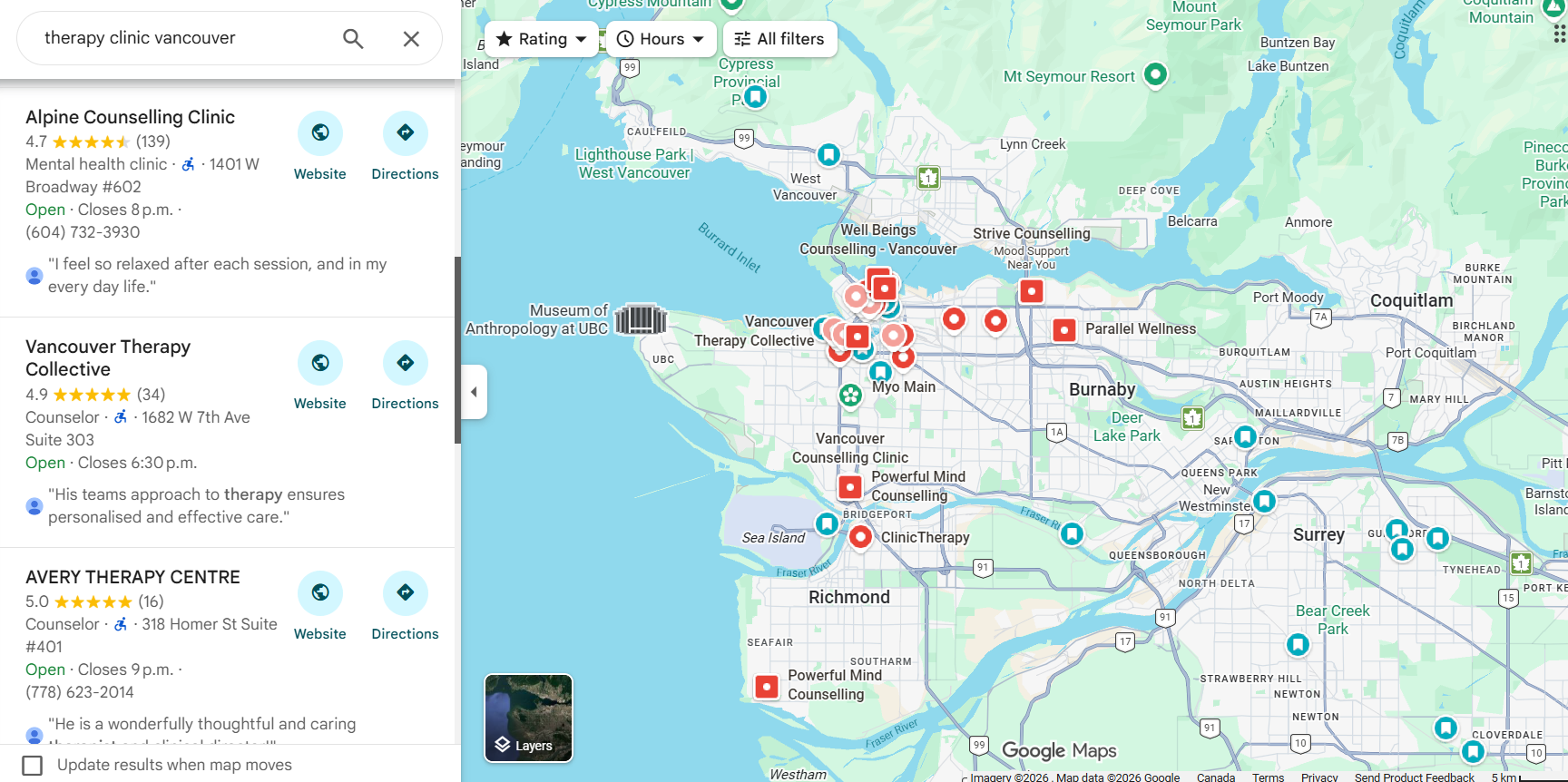
Google Maps Has Become a Major Visibility Layer for Therapists
Google Maps is not just a navigation tool.
For many local service businesses, including therapy clinics and wellness practices, it functions as an ongoing visibility channel operating in the background 24/7.
Potential new clients often use Google to:
Compare therapists and counselling clinics
Read reviews
Browse websites
Check availability and booking options
Narrow down providers before reaching out
Think about your own search behavior for a moment.
If you were searching for any type of service or business in a new area, would you rely only on referrals?
Or would you likely open Google, compare a few businesses, check out their reviews, and look at their websites before making a decision?
Through my research across Vancouver therapy clinics and solo practitioners, one pattern became increasingly clear:
Many counselors are still underutilizing Google visibility and missing opportunities to consistently connect with potential new clients already searching for them online.
Many Therapists Still Rely Too Heavily on Directories and Referrals
Directories like Psychology Today play an important role within the therapy space.
They absolutely support discoverability and you should be optimizing on those directories too.
However, one of the strongest patterns observed was how heavily many counsellors rely on directories while underutilizing Google visibility itself.
In some cases, therapists were easier to find inside a directory than through Google search or Google Maps.
This creates a visibility limitation.
Directories place practitioners beside dozens of competitors offering similar specialties, similar credentials, and similar messaging.
Why Strong Therapy Practices Still Struggle to Show Up Online
One of the more interesting observations from analyzing therapy clinics and solo counselling practices online is that many actually have visually professional websites.
However, visibility gaps often still exist beneath the surface.
In many cases, the issue is not poor design.
It is that they are not optimized for local search.
These are the issues I observed.
Underdeveloped Google Business Profiles
Many therapy and counselling practices still have incomplete or even non-existent Google Business Profiles.
Underdeveloped profile’s have issues such as:
Weak or missing service categorization
Minimal or inconsistent review activity
Incomplete business information
Poor SEO optimization for local search visibility
Websites That Look Professional But Lack Search Clarity
Many therapist websites are aesthetically polished but still difficult for Google to clearly interpret.
This included:
Services either not being clearly listed or using non-searchable phrasing
Missing location keywords throughout the website (this is one I see very often)
Weak keyword and search phrasing alignment
Thin website content with very little information for Google to understand and rank
When dozens of clinics are competing within the same geographic area, strong Local SEO becomes increasingly important.
Booking Friction Still Exists
Another pattern observed across both clinics and solo practitioners was booking inconsistency.
Jane App appears to be one of the most commonly used booking systems across the wellness space, particularly among larger clinics.
However, some practitioners still create unnecessary friction through unclear or outdated booking pathways like the use of contact forms.
If two therapy clinics both appear in Google search and have strong reviews, the clinic with the easier and clearer booking process will often be the one a potential client chooses.
Make it both easier for people to find you AND book services with you.
Being a Great Therapist Still Matters. But Online Visibility Helps More Clients Find You.
Strong referrals and reputation still matter when it comes to long-term trust and credibility.
But referrals are also unpredictable.
If you are wondering why your therapy practice is not showing up online, the issue is often not the quality of care being offered. It is usually gaps in local search visibility, Google optimization, or overall online discoverability.
A well-structured online presence helps ensure your practice appears where potential clients are already searching for support.
This is not about aggressive marketing tactics.
It is about making it easier for the right people to find the services that you are offering.
Why a Strategic SEO Advisory Can Be a Valuable Starting Point
Many wellness practices do not realize where their visibility gaps exist until someone analyzes the full local search environment around them.
In competitive markets like Vancouver, even small weaknesses across Google Maps visibility, website structure, reviews, or local search positioning can significantly impact discoverability over time.
Our Strategic SEO Advisory is designed specifically for established wellness practices navigating competitive local search markets.
This private 60-minute advisory session includes:
Google Maps visibility analysis
Website and local search observations
Competitive landscape insights
Search positioning review
Strategic recommendations for improving discoverability
Learn more and book your Strategic SEO Advisory.